Top Power Bank Charger Suppliers for Global Buyers

Time:2026-10-21 Author:Mason
0%

Global demand for portable charging is expanding, but supplier quality remains uneven. Grand View Research estimates that the global power bank market reached approximately USD 13.61 billion in 2023. The same report forecasts an 8.3% compound annual growth rate from 2024 to 2030. Smartphone dependence supports this momentum. IDC reported about 1.23 billion smartphone shipments worldwide in 2024.

A reliable Power Bank Charger supplier must offer more than attractive capacity figures. Buyers should examine USB-C Power Delivery performance, battery-cell origin, thermal protection, cycle testing, and shipment documentation. Compliance evidence matters too, including applicable IEC 62133-2 testing and UN 38.3 transport documentation. Capacity labels can mislead. A 20,000mAh unit may deliver less usable energy after voltage conversion and efficiency losses. Small details matter, such as connector durability, cable quality, and charging behavior at 45°C.

Isidor Buchmann, founder of Battery University, states, “A battery is a chemical product and will age whether used or not.” His warning is especially relevant for distributors managing warehouse stock. Older inventory may show weaker runtime, even when packaging looks perfect. This guide compares leading Power Bank Charger suppliers through a practical purchasing lens: product engineering, manufacturing experience, certifications, customization, warranty support, and export reliability.

The market is not simple. Some data remains difficult to verify. Supplier claims deserve independent review. Buyers should request test reports, production samples, and recent audit evidence before placing large orders. That extra step may feel slow. It can prevent expensive surprises.
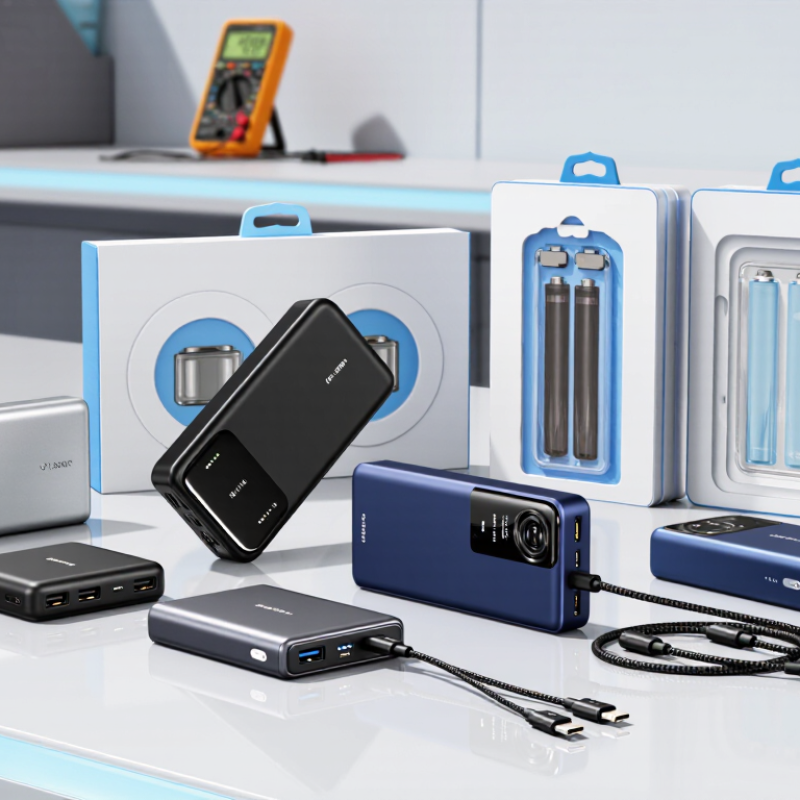
Top Power Bank Charger Suppliers for Global Buyers

Global Power Bank Suppliers: Capacity, Output, and Regional Demand Metrics

Top Power Bank Charger Suppliers for Global Buyers

Global power bank suppliers now compete on capacity, output, and measurable reliability. Grand View Research valued the global power bank market at about USD 13.6 billion in 2023. It forecasts an 8.1% compound annual growth rate from 2024 to 2030. These figures make supplier verification more important, not less.

Capacity needs regional context. A 10,000mAh unit suits daily commuting, while 20,000mAh models support travel and unstable electricity access. However, cell capacity is not the same as usable output. Conversion losses commonly reduce delivered energy by roughly 10% to 20%. Suppliers should publish rated capacity, conversion efficiency, cycle testing, and temperature results. Many listings still hide these details. That is a weakness.

Output also changes purchasing decisions. USB Power Delivery Revision 3.1 supports power levels up to 240W, according to USB-IF technical specifications. Most portable products remain below that ceiling. Buyers often need 20W to 30W for phones and at least 65W for selected laptops. GSMA’s Mobile Economy 2024 report counted 4.7 billion mobile internet users in 2023. Demand therefore varies sharply across regions, from urban fast-charging markets to areas where long runtime matters more than speed. Suppliers should provide independent test reports, connector details, warranty terms, and shipping-ready documentation. Claims without test conditions deserve caution.

Top Power Bank Charger Suppliers for Global Buyers

Global Power Bank Suppliers: Capacity, Output, and Regional Demand Metrics

The comparison uses typical market benchmarks rather than company-specific data. Capacity is shown in thousand mAh, maximum USB-C output in watts, and regional demand is represented by a normalized index where 100 equals the highest benchmark in the comparison.

Battery Capacity Benchmarks: Wh Ratings Under IATA’s 100 Wh Rule

Top Power Bank Charger Suppliers for Global Buyers

Battery capacity should be checked in watt-hours, not only milliamp-hours. IATA generally limits spare lithium-ion batteries to 100 Wh for carry-on travel without special airline approval. Power banks belong in cabin baggage, not checked luggage. However, airline policies can differ, so global buyers should confirm current requirements before shipment or travel.

The calculation is simple: Wh = mAh × nominal voltage ÷ 1,000. A 20,000 mAh unit at 3.7 volts equals about 74 Wh. A 26,800 mAh unit reaches roughly 99 Wh.

Small label errors matter. Suppliers should show capacity, voltage, watt-hours, and battery chemistry clearly on product markings and documents. Buyers should also request test reports and packaging photos.

In practical sourcing reviews, advertised capacity sometimes looks impressive but lacks a clear voltage basis. That deserves questions, not assumptions. A capacity label can still be incomplete.

Tips: Ask suppliers to state both rated and nominal capacity. Confirm whether the printed Wh value matches the calculation. Request dimensions, net weight, charging specifications, and transport documents. Keep written airline confirmation for unusual routes. The 100 Wh threshold is useful, but it is not a universal travel guarantee. Rules may change, and airport staff may interpret documentation differently. Better records reduce delays.

Charging Standards: USB PD 3.1 Supports Power Delivery Up to 240 W

For global buyers, USB Power Delivery 3.1 deserves close attention when comparing power bank charger suppliers. The standard can deliver up to 240 W through Extended Power Range (EPR). It supports higher voltage profiles, including 28 V, 36 V, and 48 V. This matters for laptops, portable monitors, and compact professional equipment.

However, a 240 W label does not guarantee 240 W from every port. Buyers should request the power profile, sustained-output test, and compatible cable specification. A certified 5 A cable is essential for higher EPR levels. Suppliers should also explain heat control, battery chemistry, charging cycles, and protection against overcurrent and overtemperature. Ask for test reports, not only catalog claims. Small details matter.

There is a practical weakness here. Higher output usually increases heat, size, and design pressure. A power bank may reach 240 W briefly, then reduce output in a warm room. That is not necessarily a failure, but suppliers should state the operating conditions clearly. During evaluation, test a real laptop under continuous load. Check connector temperature after thirty minutes. Review production consistency between samples. Some buyers focus too heavily on peak wattage and overlook recharge speed, idle loss, or cable availability. A reliable supplier discusses these limits openly and updates specifications when testing reveals problems.

Supplier Compliance: IEC 62133-2, UL 2056, and UN 38.3 Testing

For global buyers, a power bank supplier must prove more than battery capacity and charging speed. Ask for current test reports covering IEC 62133-2, UL 2056, and UN 38.3. These standards address different risks. IEC 62133-2 examines rechargeable lithium battery safety during use. UL 2056 focuses on power bank construction, electrical protection, and abnormal conditions. UN 38.3 supports safe transport by testing vibration, shock, altitude, temperature cycles, overcharge, and forced discharge.

Request reports that match the exact model, cell type, rated capacity, and production version. A document with a similar model number is not enough. Check the laboratory name, test dates, report scope, and accreditation details. Keep a sealed production sample beside the paperwork. It helps reveal quiet changes in cells, circuit boards, insulation, or enclosure materials. Small differences matter.

Supplier control should continue after approval. Review incoming-cell records, protection-board checks, charging tests, and batch traceability. Ask how failed units are isolated and recorded. A strong supplier can explain the answer without searching for it. Still, paperwork is not proof of perfect production. Reports may be old, incomplete, or linked to an earlier design. That is the uncomfortable part. Re-test after major component changes, and use independent inspections when shipment risk is high. Clear evidence, consistent manufacturing, and honest technical communication give buyers a more dependable compliance decision.

Global Supplier Comparison: MOQ, Lead Times, Certifications, and Warranty KPIs

Top Power Bank Charger Suppliers for Global Buyers

Global Supplier Comparison: MOQ, Lead Times, Certifications, and Warranty KPIs

A practical supplier comparison starts with minimum order quantity, not catalog size. Some suppliers accept 100 units for samples, while production orders may require 1,000 or more. Ask whether the MOQ applies per model, color, or total shipment. This detail can change your landed cost quickly. Request a written lead-time schedule covering sampling, battery procurement, assembly, testing, and dispatch. In my purchasing experience, a quoted 15-day lead time often excludes component shortages. That estimate needs checking.

Certification records deserve direct verification. Ask for current test reports, product markings, and factory quality procedures relevant to the destination market. Reports should match the exact model, battery capacity, and charger configuration. A certificate for a similar product is not enough. Review sample units before approving mass production. Check charging temperature, port alignment, cable fit, and printed capacity. Small faults often become expensive after shipment.

Warranty performance should be measured with clear KPIs. Useful figures include defect rate, response time, replacement time, and warranty-claim closure rate. For example, a supplier may promise a 12-month warranty but take three weeks to answer one claim. That is a service risk. Define evidence requirements, return handling, and spare-unit support in the contract. No comparison is perfect. Factory audits and independent inspections still involve cost, scheduling limits, and occasional blind spots. Track results across several shipments before increasing order volume.

Top Power Bank Charger Suppliers for Global Buyers - Global Supplier Comparison: MOQ, Lead Times, Certifications, and Warranty KPIs

Supplier Profile Typical Product Focus Typical MOQ
(Units/SKU)
Sample Lead Time Mass-Production Lead Time Common Certifications & Documents Standard Warranty Reported Warranty Rate Typical Defect Rate at Shipment Best-Fit Buyer
Profile A Entry-level 5,000–10,000 mAh power banks 500–1,000 5–8 business days 25–35 business days UN 38.3 test summary, MSDS/SDS, CE, RoHS, FCC 12 months 1.0–2.0% ≤1.5% Promotional distributors and test orders
Profile B 10,000–20,000 mAh fast-charging models 1,000–2,000 7–10 business days 30–40 business days UN 38.3, IEC 62133-2, CE, RoHS, FCC, MSDS/SDS 12 months 0.7–1.5% ≤1.0% E-commerce and regional wholesalers
Profile C USB-C PD and multi-port charging banks 1,000–3,000 8–12 business days 35–45 business days UN 38.3, IEC 62133-2, CE, UKCA, RoHS, FCC, EMC reports 12–18 months 0.5–1.2% ≤0.8% International online retailers
Profile D Rugged, outdoor, and high-capacity models 500–1,500 10–15 business days 40–55 business days UN 38.3, IEC 62133-2, CE, RoHS, FCC; IP test report where applicable 18–24 months 0.4–1.0% ≤0.8% Outdoor, travel, and professional-equipment channels
Profile E Wireless-charging and magnetic-compatible models 1,000–2,000 10–14 business days 35–50 business days UN 38.3, IEC 62133-2, CE, RoHS, FCC, wireless EMC documentation 12–18 months 0.6–1.4% ≤1.0% Consumer-electronics and lifestyle retailers
Profile F Customized OEM/ODM power-bank programs 3,000–10,000 12–20 business days 45–70 business days UN 38.3, IEC 62133-2, CE, RoHS, FCC; factory audit and QC records 12–24 months 0.3–1.0% ≤0.5% Global brands, importers, and private-label programs
Data note: The figures above are anonymized industry benchmark ranges for buyer comparison and are not attributed to any specific company or brand. Certification requirements vary by destination market, battery capacity, transport mode, and product configuration. Warranty-rate and defect-rate figures should be verified through supplier quality records, inspection reports, and recent shipment data.

FAQS

What capacity suits most daily users?

A 10,000mAh model suits commuting and short workdays. A 20,000mAh model supports travel or unreliable electricity. Actual output is lower.

Why is rated capacity different from usable energy?

Conversion losses commonly reduce delivered energy by 10% to 20%. Ask for rated capacity and tested efficiency. Labels can mislead.

What output is suitable for phones?

Most phones need about 20W to 30W for fast charging. Check the charging profile, port details, and cable requirements. More watts are not always better.

What output may selected laptops require?

Some laptops need at least 65W during normal use. Higher-power models may need more. Test a real laptop under continuous load.

Does a 240W rating guarantee continuous 240W output?

No. Peak output may last briefly. Heat can reduce performance in a warm room. Ask for sustained-output results and test conditions.

Which details should buyers request from suppliers?

Request independent test reports, cycle results, temperature data, warranty terms, and shipping documents. Also request production consistency records. Catalog claims alone are weak.

Why does cable compatibility matter at higher output?

Higher power levels may require a certified 5A cable. Confirm voltage profiles and connector types. A powerful charger with the wrong cable disappoints.

How should buyers compare suppliers across regions?

Urban users may value fast charging, while remote users may prioritize runtime. Compare recharge speed, idle loss, heat control, and service support. I would not judge by capacity alone.

What practical test can reveal a weak power bank?

Run a laptop continuously for thirty minutes. Check connector temperature afterward. Repeat the test with several samples. One successful sample proves little.

What information should a trustworthy supplier disclose?

The supplier should explain battery chemistry, protection systems, charging cycles, operating limits, and output reduction. Honest limits build confidence. Missing details deserve caution.

Conclusion

This guide helps global buyers evaluate Power Bank Charger suppliers through practical metrics such as battery capacity, output performance, regional demand, minimum order quantities, lead times, certifications, and warranty policies. It explains how watt-hour ratings affect shipping and airline acceptance under the commonly applied 100 Wh limit, helping purchasers select suitable capacities while planning international logistics.

The article also reviews modern charging expectations, including USB Power Delivery 3.1 and its potential support for power delivery up to 240 W when supported by compatible devices and components. Supplier compliance is assessed through key safety and transport requirements, including IEC 62133-2, UL 2056, and UN 38.3 testing. By comparing technical specifications, production reliability, documentation, and after-sales commitments, buyers can identify dependable suppliers and reduce risks in large-scale procurement.


Mason

Mason

Mason is a seasoned marketing professional with a deep expertise in the company's offerings and a passion for driving brand awareness. With a strong background in digital marketing strategies, he has an innate ability to connect with diverse audiences and effectively communicate product benefits.......